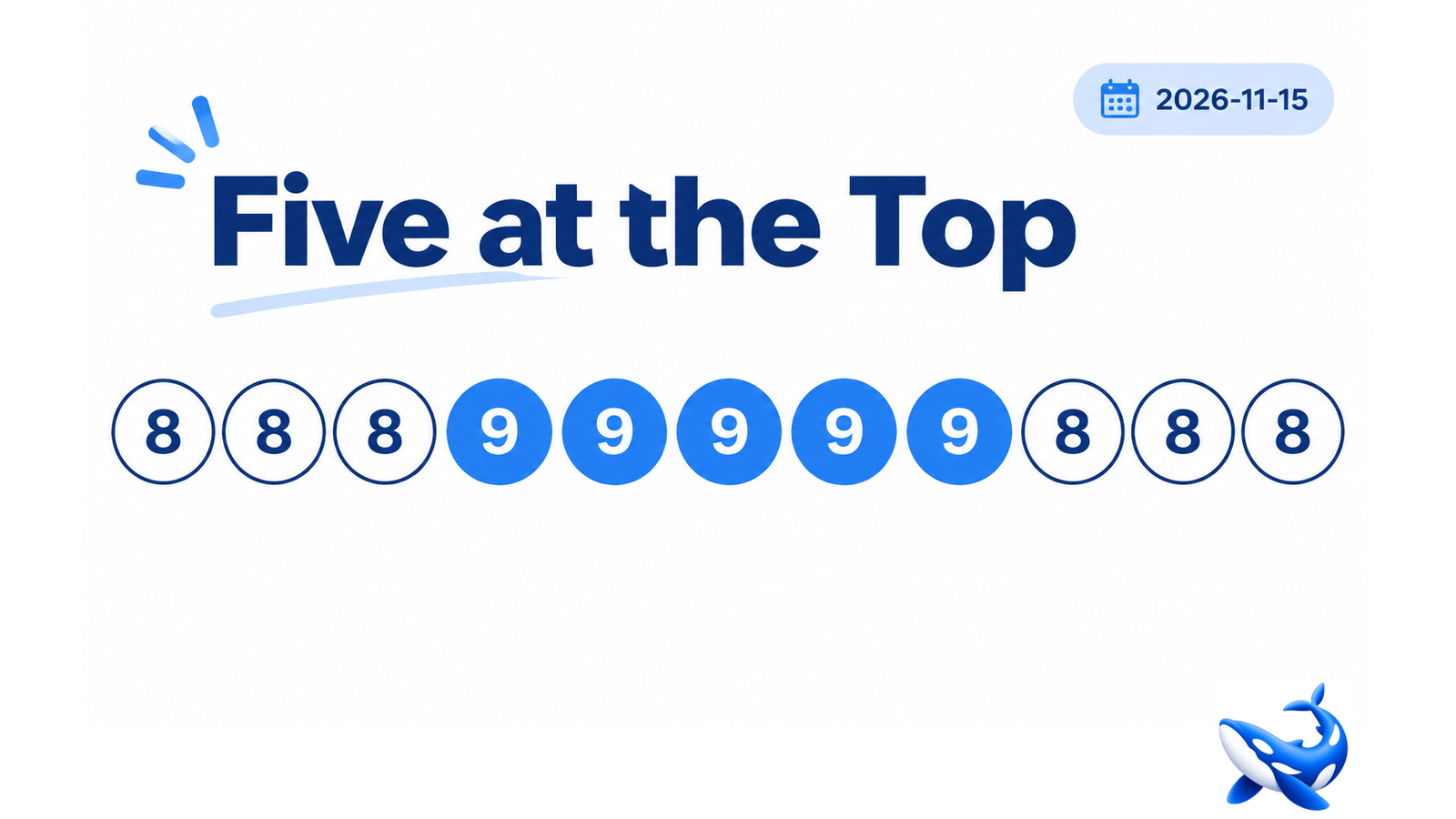
Every card on OrcaRouter‘s cyber tier carries a quality score out of ten. Five carry a nine, six carry an eight, and nothing carries a ten [OURS]. The five at nine are Kimi K3.1 Pro, GLM 5.3, OrcaCyber Zero 1.5, Zero 1.0 and Ultra 1.0.
The score is the least defined number on the page. It is a vendor judgement rather than a benchmark, and no card explains its basis — but the pattern of who gets a nine is informative, because it maps onto something you can check.
Who gets a nine
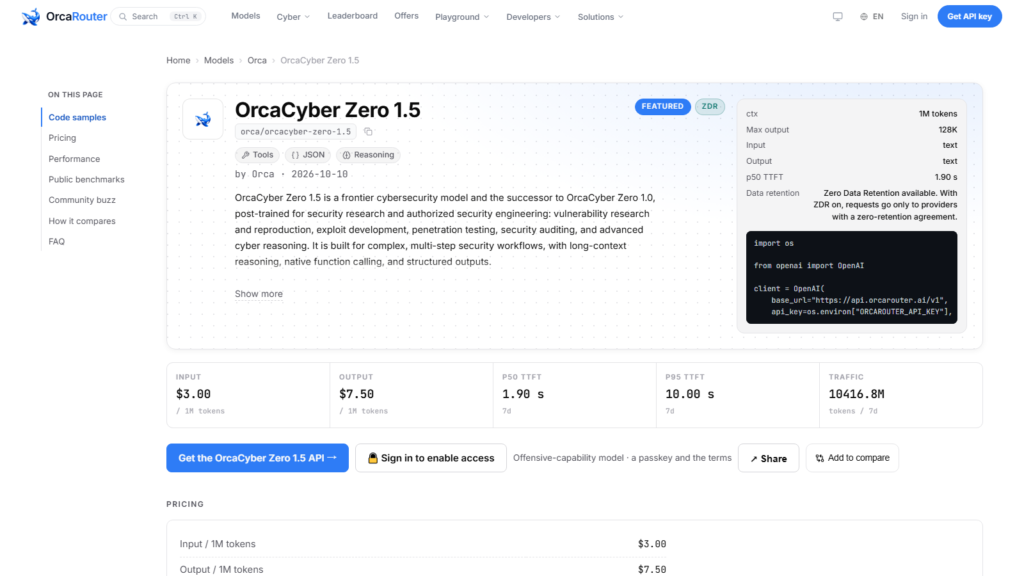
Four of the five are the expensive cards. Kimi at $8.00 blended, GLM 5.3 at $3.50, Zero 1.0 and Zero 1.5 at $4.13, Ultra at $6.25.
The fifth is not: MiniMax sits at eight, at $1.00 blended.
So the nine is mostly price-correlated rather than capability-correlated, with price as a proxy for the vendor’s own valuation rather than for measured quality. Two cards at the bottom of the price range score higher than several at the top on objective rows, and they still get an eight.
That is not an accusation. A quality score is a judgement and judgements are allowed to be qualitative. It is a warning about what the number can be used for.
What the nine correlates with on measured rows
| card | score | blended | tok/s | p50 | error % |
| Kimi K3.1 Pro | 9 | 8.00 | 62.0 | 1,989 | 1.306 |
| GLM 5.3 | 9 | 3.50 | 87.4 | 3,260 | 16.110 |
| Zero 1.0 | 9 | 4.13 | 199.5 | 1,936 | 0.183 |
| Zero 1.5 | 9 | 4.13 | 122.2 | 1,901 | 0.859 |
| Ultra 1.0 | 9 | 6.25 | 205.7 | 2,903 | 1.059 |
| DeepSeek | 8 | 1.00 | 186.1 | 998 | 0.166 |
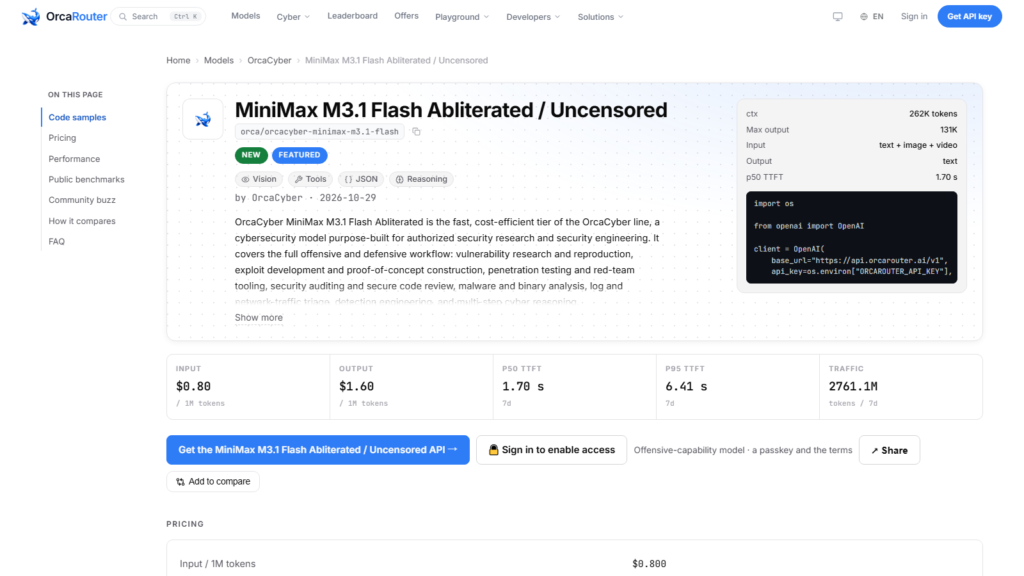
| MiniMax | 8 | 1.00 | 129.9 | 1,695 | 0.272 |
[OURS], seven-day windows ending 2026-11-15.
Read the rows and the nine does not predict speed, latency or reliability. Zero 1.0’s 199.5 tokens a second sits beside GLM 5.3’s 87.4. Ultra’s 1.059% errors sit beside GLM 5.3’s 16.110%. DeepSeek beats every nine on median and error rate and still scores an eight.
What the nine does correlate with is price, with one exception in each direction.
The one row where a nine is defensible
Benchmark evidence.
Two of the five nines publish benchmark rows, and both are post-trained: Zero 1.0 with CyberGym 98.07 and Zero 1.5 with four rows including CVE-Bench 95.8 [VENDOR]. Kimi, GLM 5.3 and Ultra publish none.
The eight group is mixed: MiMo, Qwen, GLM 5.3 Flash and MiniMax publish rows, DeepSeek publishes six, and anything unpublished sits at eight.
So the score tracks neither evidence nor speed. It tracks the vendor’s positioning of the card, which is a legitimate thing for a vendor to do and a poor basis for a purchase.
How to use it
One use, and it is narrow.
As a tiebreaker between two cards that are otherwise identical on your rows. Once you have filtered by ZDR, modality, ceiling and protocol, if two cards remain and one scores nine against the other’s eight, the nine is a weak signal in its favour.
That situation occurs rarely. On this tier, six abliterated cards sit at $0.80/$1.60, and the filter usually leaves one of them — MiniMax, at eight, with the best serving rows in the group.
Using the score before the filters produces the wrong answer almost every time: it eliminates the tier’s best-value cards and selects the tier’s most expensive, for a reason nobody can cite.
What a score of eight means
Six cards: DeepSeek, Qwen3.8 Flash Next, GLM 5.3 Flash, MiMo V2.6 Flash, MiniMax M3.1 Flash, Hy4.
All six are abliterated. All six are at exactly $0.80 in and $1.60 out. And among them are the tier’s fastest median, its lowest error rate, its highest security benchmark and its only audio input [OURS, VENDOR for the row].
An eight here is not a demotion. It is what a vendor gives a card whose value is in its serving rows rather than its positioning — and the six cards at eight are, on the measured rows, the most useful set on the shelf for high-volume work.
The five at nine are the cards you escalate to. That is a coherent reading of the whole page, and it is the opposite of the reading the score invites.
The question the score does not answer
Whether a card is right for your job.
Seven of the eleven score eight or nine; four score eight or nine among the ones that matter. The score cannot distinguish between a card that takes audio and one that does not, between a 65,536-token ceiling and a 943,718-token one, or between an endpoint surface of one protocol and three.
Those distinctions decide purchases. The score does not, and treating it as if it did is how a team ends up paying $4.13 blended for a card whose usefulness is a 122.2-token-per-second text-only endpoint when a $1.00 card would do the same job at 186.1.
What the score is probably measuring
One hypothesis fits the data better than the others: the score reflects how much post-training and positioning a card carries rather than how well it serves.
The three post-trained cards all sit at nine. The two most expensive abliterated cards sit at nine. The six flat-tier abliterated cards all sit at eight.
Under that reading the score is a classification in disguise — post-trained or premium versus commodity — and the honest way to use it is as a shortcut for that classification rather than as a quality judgement.
That is useful, because the classification matters: post-trained and commodity cards are different products with different evidence. It is just not what the number appears to say.
What to check instead
Three rows, in this order, and every one is measurable.
Does the card publish benchmark rows, and were they evaluated for the card or for its checkpoint? That distinction separates the two kinds of evidence on this page.
What does its serving profile look like on the row your workload depends on — median for interactive work, throughput for generation, error rate for unattended runs?
Does its price per effective token match the job? A card at $8.00 blended producing 200-token classifications is paying for capability it is not using.
The score can be the fourth check. It should never be the first.
The short version
Five cards score nine, six score eight. The nines are the four expensive cards plus the post-trained pair; the eights are every flat-tier abliterated card.
The score tracks price and post-training, not speed, latency, reliability or evidence. It is a classification wearing a quality label.
Use it as a tiebreaker after the rows that matter, and only then. On this tier the cards scoring eight are the ones most teams should be buying.
Sourcing note: quality scores, prices, context windows, output ceilings, modalities, latency, throughput, error rates and traffic are read from the eleven cards’ public model data on 2026-11-15, with seven-day windows ending that day [OURS]. Blended prices are our arithmetic at a 3:1 input-to-output mix. Benchmark rows quoted are OrcaCyber’s own [VENDOR]; no basis for the quality score is published on any card.